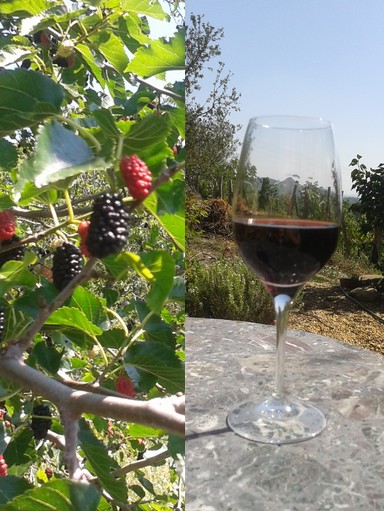
Continuing in a series, of indeterminate length, of fruit wine, I decided to write about another fruit that grows on our property and which makes excellent wine: the mulberry tree. We have both white and black mulberry trees, and the black mulberry is here used to make the wine (the white mulberry is of course better known for its leaves, both as the preferred food of the silkworm, and as an excellent tea).
Black mulberry produces a full bodied red wine. And this means, unlike cherry wine, mulberry wine needs several months (6 to 12) of maturation time to soften and refine the flavors before it becomes ready to drink.


We purchased a property last year in part because it had on it several very large mulberry trees. And true to expectations, the trees where bearing a large crop this spring.
Unfortunately, the day before a planned harvest a large wind blown storm came which knocked out of the trees most of the berries. Such are the fickle way of nature with which a farmer must contend. And we had to content ourselves with what was left on the branches after the storm for this year’s wine.
Even today, months later, the vast and numerous stains on the ground left by the sacrificed mulberry berries are still evident. Like little fossilized memories of what could have been.
Oh well. I look forward to next year, both toward the maturation of the wine and for the next harvest. And of course not all is lost, as the leaves are still harvested for tea.



 Another Tramp Abroad
Leave a comment